Showing posts with label Image of the Week. Show all posts

Monday, June 2, 2014

Columbus Zoo Heart of Africa Vervet Monkey

Are Columbus Zoo: Heart of Africa series continues with a look at the vervet monkeys. These monkeys have taken over Jack Hanna's base camp. There are 27 vervet monkeys kept in three different groups. The zoo keepers can use different setups to keep the exhibit fresh and interesting for visitors and monkeys alike.

Watch the vervet monkeys wreck havoc on Jack's camp below:


We'll have a final post on Heart of Africa soon!

Sunday, April 28, 2013

Manta Ray at the Atlantis Resort

 
While on a recent cruise on the Disney Dream we had the opportunity to explore the incredible Atlantis Resort on Paradise Island in the Bahamas. The Dig is a series of aquariums located beneath the main lobby and spread throughout the resort. Unlike other aquarium attractions, there is no central building with a roof. Most of the fish tanks are open air and sit directly under the brilliant Bahamian sun. The Dig is also highly themed to the ruins of the Lost City of Atlantis. Notable species found here include angel fish, eels, sea turtles, jellyfish, and hammerhead sharks.


One of the larger exhibits, dubbed “The Predator Lagoon,” features a 100 foot long clear acrylic underwater tunnel passing through a tank of sawfishes, sharks, stingrays, and barracudas. It’s very similar to the one found at Ripley’s Aquarium of the Smokies. The entrance is in the middle of this giant sea star themed building that also houses a restaurant.


Of course, the marquee animal currently on display is the magnificent Manta Ray. Atlantis is one of only four aquariums in the world to house manta rays. Our tour guide said this ray is just a baby which was quite surprising to hear because its wingspan was over ten feet across! The pictures do not do it justice - this guy was huge! Mantas use the fins on the side of their heads to help channel food into their mouths.


Unfortunately, we did not get to see the dolphin and sea lion area, which is on the opposite side of the resort. The dolphins are also kept in an open air exhibit and for an exuberant fee you can swim and interact with them. Our tour was only $30 a person and included transportation from the port to the resort and back. I was under the impression the resort is broken up into different areas requiring different tickets to get into but we were pretty much free to walk around wherever we liked, including the breathtaking beach with its amazing, crystal clear water.


Check out my video montage of the Atlantis resort and the manta ray below!
 

Sunday, March 10, 2013

Columbus Zoo Update March 2013

We took a trip to the Columbus Zoo on Saturday, March 9th to see what was going on and if anything was new. In the latest edition of the Beastly Banner, the zoo president and CEO Tom Stalf said "We are moving to Phase II of the Safari Africa construction project. I was impressed with the 60 large trees that were planted throughout the area. This process happened in just a few days and it really transformed the area. The completion of the area will be in the summer of 2014. Giraffes, zebras, and lions will be some of the featured animals." At this point none of the Safari Africa construction can be seen from inside the zoo, other than mounds of dirt, markers, and construction equipment. The construction is going on right behind the grizzly bear enclosure.

Tom also talked about the zoo's 2013 plans in the magazine: "In honor of Jack, we are excited to provide a dinosaur experience. Enjoy walking through the Jurassic era and come face-to-face with these amazing creatures. This exhibit will also include our boat ride tour as you travel by many dinosaurs, ranging from the size of your hand to our T-rex that is larger than a city bus!" The dinosaurs are going to be found in the Islands of Southeast Asia region of the zoo. While visiting the zoo I spotted numerous red and yellow flags in the ground which I suspect are the future locations of the dinosaurs and I snapped a few pictures (seen below).

A couple other of my own notes and observations:

  • All three polar bears were out in the yard and playing, the first time I have seen all three at once.
  • It looks like a new cage was added to the bat exhibit in Asia Quest to separate some of the bat species.
  • A new Colobus monkey was born at the zoo recently but, of course, is not on public display yet.
Enjoy our pictures from the Columbus Zoo!

columbus zoo polar bears
grizzly bear columbus zoo
silvery lutung lounging around
columbus zoo roadhouse
gorilla at the columbus zoo

Columbus Zoo possible early Dinosaur exhibit construction (I believe the placement of the flags is where the animatronic dinos will be):

 columbus zoo dinosaur
dinosaurs at the columbus zoo
columbus zoo dinosaur location
columbus zoo dinosaur cost

Sunday, November 18, 2012

Wildlights at the Columbus Zoo 2012 Review


Wildlights at the Columbus Zoo and Aquarium began this week and so we went out Saturday night to get some pictures and video to share with you. The main attraction is the Animated Light Show which takes place all around Conservation Lake in the middle of the park. The focal point of the show is a giant 24-foot diameter globe floating on the lake. Watch my video embedded below to see the show in its entirety (and more, including the tiger cubs): 


A new addition to Wildlights Columbus Zoo is the Global Celebrations Village. Located in the Asia Quest building, this attraction features animated international carolers that look like dolls taken straight out of Disney's "it's a small world." You can also meet Santa Claus himself (in the Jungle Jack’s Landing area) and his reindeer (in the North America section).


Pictured below is the Columbus Zoo map seasonal Wildlights edition.

seasonal zoo map

One thing to be aware of if you do go to the zoo during Wildlights - don't expect to see a huge number of animals. Some entire areas of the zoo, such as Expedition Congo: African Forest, are completely closed off. The North American section, which you would think would be one of the better areas this time of year, is just too dark to really see any animals very well. The good news is that nearly every region had at least one building you can go into to warm up and see some animals, like Hank, the enormous elephant!


The Columbus Zoo Wild lights run through January 1, 2013. There's no better way to get into the holiday spirit than by seeing the Columbus Zoo Christmas lights!

Sunday, November 11, 2012

Columbus Zoo Update 11-10-2012

columbus zoo baby tigers

I went to the Columbus Zoo and Aquarium yesterday for the first time since August. A few observations and changes since my last visit:

    beavers at the columbus zoo
  • It looks like they’ve expanded the pathway leading into the North America section (next to the elephant building).
  • I still haven’t seen the otters out in the old black bear enclosure.
  • There was a single beaver occupying the old otter enclosure that I could see (rumored to soon have four beavers). 
  • The tiger cubs were playing outside, the first time I have seen them in person. I shot a short video of the cubs. There is also a short segment at the end with the gibbons. They were so loud yesterday, you could hear them all the way at the other end of the zoo in the Polar Frontier region. Crazy!
  • A large gorilla statue was added to the Expedition Congo: African Forest section outside the entrance to the gorilla building.
  • Safari Africa expansion construction is well under way. Looks like a chain link fence is being erected around the entire site, which is currently nothing but dirt
  • Zoo crews were going gangbusters setting up Christmas lights and decorations for the Wildlights at the Columbus Zoo with opening only a week away! They were also setting up a neat looking “Christmas Around the World” type display in the Asia Quest building complete with figures that looked like they came directly out of Disney’s “it’s a small world” ride.
a sleeping smiling monkey at the zoo

Stay tuned for our future updates as we will cover Wildlights and the ongoing construction of Safari Africa.

Tuesday, August 7, 2012

Wednesday, August 1, 2012

The Sea Otters of Monterey Bay

While visiting the beautiful city of San Francisco earlier this summer I made a side trip down the coast to Monterey. Read part one of my review of the excellent Monterey Bay Aquarium. Today, I’m going to continue my review by showcasing one of my favorite animal encounters ever, both in captivity and in the wild.

The main attractions of the Monterey Bay Aquarium are the sea otters which can be seen in captivity inside the aquarium and in the wild from the observation decks outside the aquarium. I was initially shocked at how big the sea otters are up close. I had seen river otters and Asian small clawed otters at the Columbus Zoo and Aquarium but they are tiny in comparison. Here are a few facts about sea otters as well as my sea otter pictures.


Sea otters don’t rely on blubber to survive the frigid waters of the Pacific Ocean like other mammals. Instead, they have the densest fur of any animal on the planet. I’d love to feel sea otter fur. Sea otters can live their entire life without leaving the water. Did you know sea otters live in groups called rafts?


What do sea otters eat? Sea otters eat sea urchins and other mollusks and crustaceans. This includes clams, snails, sea stars, sea urchins, squid, and octopuses. How would you like to eat sea otter food? They can hold their breath for up to five minutes, allowing a long dive to the ocean floor to hunt for food. They use rocks as tools to crack open prey.


Where do sea otters live? The otters seen from the decks of the Monterey Bay Aquarium are called southern or California sea otters. Sea otters are an endangered species. One ill-timed oil spill could essentially wipe out the entire Monterey Bay sea otter population. To see the otters up close you can kayak out into the calm waters of the bay, which I would LOVE to go back and do.

Embedded below is my Monterey Bay Aquarium montage video, featuring scenes with the sea otters inside as well as out in the bay. Sorry for some of the shaky footage. Enjoy!


Read my review on the rest of the exhibits at the MontereyBay Aquarium.

Tuesday, July 10, 2012

Zoo Interpreter Interview


We have another great Zoo Tale to share with you today. Andrew King is a zoo photographer and worked as a zoo interpreter at the Seneca Park Zoo. Thanks to Andrew for sharing his adventures and zoo photography tips with us.

ZT: Could you please tell us a little bit about yourself?

My name is Andrew and I am originally from Western NY State. I lived there mostly all my life, but I moved down to Maryland a little over a year ago. I went to the University at Buffalo for theater performance. Although I loved my major and used my talents in some of my jobs, I needed something more stable. I got retail work, which lead to jobs in hospitality. Currently I am the head guest service agent at one of the top hotels in Hagerstown, MD. This has been a blessing when I plan zoo trips as I am offered very cheap rates when I stay at a hotel in our company’s chain.

ZT: Where did your love of zoo animals originate?

My earliest memory is being pushed around a stroller at a zoo. I am pretty sure it was a dream because I can remember seeing myself. It was like the start of a movie as I have a view high in the sky and then it zooms down my family walking on the side walk. I always loved animals when I was a kid. My uncle had a farm and I fell in love with cows. I planned to be a farmer until I was introduced to manatees. Then I wanted to be a marine biologist. I would get many toy animal play sets while growing up. I would go on field trips to the BuffaloZoo, Seneca Park Zoo, and Niagara Falls Aquarium. I would borrow my grandmother’s old Zoo books until I got my own subscription. I also had those animal binders. You’d get a pack of animal fact sheets each month. Going to zoos was an occasional activity. It was great to revisit the Buffalo Zoo when I went to college. I remembered the bear grottoes, Rocky Mountain sheep hill, and the smell of the gorilla exhibit. After I graduated I found a partner who was willing to put up with my animal/zoo obsession and we began to go to zoos in nearby cities. We continue to take zoo trips and we have many zoos left to see!

ZT: What zoo do you consider your "home" zoo?

That’s a bit of a tough question. I grew up mostly visiting Seneca Park Zoo in Rochester, NY. However, I also went to the Buffalo Zoo. I also visited it weekly when I lived in the city of Buffalo for a couple years after college. Since I consider Buffalo still my home city, I would consider their zoo to be my home zoo.

ZT: How did you get involved in zoo photography? Do you do it just for fun or commercially for profit?

The funny thing is while growing up; family would not want me to take group photos for them. I would feel the pressure of having to take a great picture, but people would be off centered all the time. I am still not the greatest fan of taking photos of people. Animal and nature photography is more of my expertise. I guess it started in college. Despite being nervous taking posed photos, I enjoyed taking candid photos of friends at parties. I would always rush home afterwards and insist on uploading my photos on Facebook. It as if I want to freeze these memories in time.

Anyway, at the same time I started to visit the Buffalo Zoo again and I became obsessed taking good photos. They always had a photo contest, but I did not enter it until the year I moved back to Buffalo. During college I would see amazing close ups of animals and I always wished I had a camera that could do that. I had a point and shoot camera for awhile, but I have recently updated to a camera with a nice zoom. The first year I entered the contest I did not place at all. But I remember going to the ceremony and one of the judges encouraged us to constantly take photos, even if it was of grass, until we perfected our skills. So that year I took multiple photos and upgraded my camera. Nice captures started to happen more often. So a year later I place second place in the bird category. For the 2011 contest, I was a judge’s choice in the reptile category for my photo of a green crested basilisk.


I only take photos for fun. Going to zoos relax me. When I can forget everything and have my focus on capturing a certain moment, I feel at ease. I think I may have tried to sell my prints on websites like Red Bubble in the past, but I never got anyone to buy anything. I don’t mind being an amateur photography that does it for the pure joy of it.

ZT: Many readers ask me “how to work at a zoo” or “how do you become a volunteer at a zoo.” Are there any requirements to work at a zoo?

I found out about the position because my high school friend worked in the education department. I was going to apply for a similar position the year before, but another job came up. But this summer I was ready for the posting and she informed me about it. I believe my theater background helped me as you had to be entertaining when you did these demonstrations. Most of the times visitors probably don't even hear you because one of the animals is doing something cool. However, to be lively it helps them to actually listen. If I heard a bored person listing off facts, I would just tune them out. A love for animals helped as well. Two out of three of us had a theatrical background. The other one was majoring in animal science and took classes in public speaking.

ZT: Describe your work in the education department at the zoo jobs you worked for in the summer? What type of jobs in zoos did you do? Describe your daily activities.

I worked at the Seneca Park Zoo in Rochester, NY during the summer if 2009. It was one of my most favorite jobs. I even went back the following summer and I helped out for a day. It was a blast to reconnect with former coworkers and animals My main job was being an interpreter for the daily animal demonstrations. The lead animal trainer in the education department came up with wonderful, short, informative scripts about the certain zoo animals. I did demonstrations for the North American river otter, white rhinoceros, African elephant, California sea lion, and the Arctic wolf. We also had a general enrichment demonstration we did on various animals depending on the day. The enrichment demonstrations I interpreted were for the meerkat, radiated tortoise, Amur tiger, olive baboon, and the North American river otter. We also did question and answer sessions during the feeding times of the American alligators and African black footed penguins. I was never a fan of the alligator Q & A’s, but I loved the penguin one. It was decided half way into the season we would go into the exhibit with the keepers and answer questions facing visitors. Before this we were just in the crowd and sometimes got lost. I also enjoyed this because I got go in their holding area beforehand and sometimes help insert pills (medicine) in the fish for the penguins.


The other part of my job was to assist with the stage show. We did a mini trip around the world showing various animal ambassadors from different continents. Animals featured were the Mallard duck, Harris hawk, sun conures, tawny owl, domesticated rat, bush baby, African gray parrot, serval, and the Virginia opossum. Although we traveled around the world, our repeated message was to emphasis to kids that they could discover the wonders of nature right there in their own backyards. The main animal trainer was responsible for actual contact and behaviors with the animals. We just helped narrate the script – sort of filled in the gaps leading into the next segment during times she had to get an animal from backstage. However, I did have contact with the Virginia opossums. They were sisters named Thelma and Louise. Louise was the one I always had and I loved her dearly, even if she drooled and farted on me. In between shows I would give them enrichment by taking them out of their cages and having them walk around. Behind the stage was a small hillside so it was perfect area to explore. I had to keep my eye on them as they sometimes tended to go in opposite directions! I would also help set up crates before shows, clean them afterwards, help cart animals to their final destination, and help set up the sound equipment. Having studied theater in college, this was a perfect job to display my skills and personality.

ZT: Of course I have to ask, what is your favorite zoo that you've been to and why?

I have not been to a lot of the major U.S. Zoos. The biggest one I have been to so far has turned out to be my favorite; the Columbus Zoo. It has a great animal collection, themed geographic sections, and is continuing to expand and improve. I loved seeing the manatees, okapis, Matschie’s tree kangaroos, koalas, and I loved the new polar bear exhibit.

ZT: The Columbus Zoo is my favorite as well. Thanks again to Andrew for sharing his Zoo Tale with us! Check out more of his zoo animals pictures here.

For more stories read our interview with another zoo photographer.

Monday, June 25, 2012

Columbus Zoo Stingray Bay Video


Stingray Bay at the Columbus Zoo and Aquarium is now open to the public. I recently visited the new attraction and took some video of the majestic stingrays doing their thing. You will see two types of rays at Stingray Bay: the smaller cownose stingray and the larger Southern stingrays. This 18,000 gallon saltwater tank allows guests to touch and feed stingrays. Timed tickets are given out if you want to come back later but in our case we were able to get in the building almost immediately after purchasing our tickets (and thoroughly washing our hands). A cup of food to feed the stingrays costs $2 (not sure if feeding is allowed only at certain times of the day or not).

Cownose stingrays are members of the eagle ray family and are found in the Atlantic Ocean. The cownose has a series of teeth and dental plates used for crushing oyster shells and clams. The cownose ray typically does have a stinger on the end of its tail with venom that cause bee sting like symptoms. Of course, this tails have been ground or clipped so as not to harm or hurt any of the visitors who wish to pet these magnificent creatures. So yes, they are safe to touch.

The southern stingray is also found in the Atlantic Ocean. Its flattened body is ideal for life on the bottom of the ocean. The ray’s spine contains a poisonous mucous which, though not fatal to humans, is extremely painful if you are unfortunate enough to step on one. The small openings on its head are called spiracles and they allow the ray to take in water while buried in the sea floor sand. Females often grow larger than males and can be up to 150 centimeters across!

Stingray Bay Tips - Best Way to Touch Stingrays 
 
As you can see in the video, the trick is to submerge your hand all the way in the hard and don't move it around. If you do this the stingray will come to you! If you try to reach out and pet them they will swim away quickly. This really works! 

Monday, April 23, 2012

Image(s) of the Week: Grizzly Bears

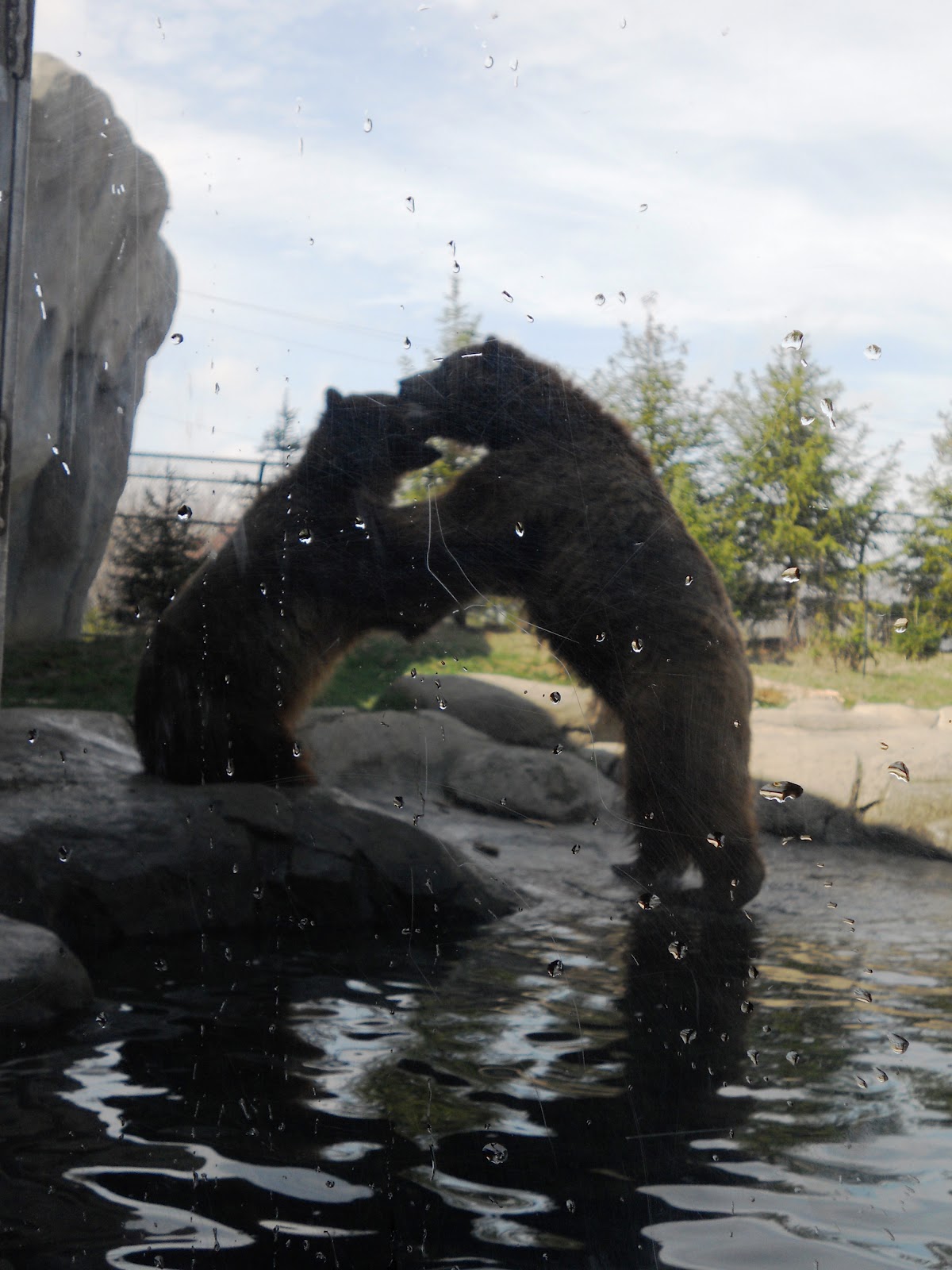
We visited the Columbus Zoo and Aquarium (again) a couple of weeks ago and the grizzly bears but on quite a show! Brutus and Buckeye were wrestling each other in the water. Amazing to watch but I wouldn’t want to be caught in the middle of it!


Thursday, April 5, 2012

Bald Eagles at Highbanks Metropark


Looking for something else to do near Columbus, Ohio? That is, of course, after you've visited the Columbus Zoo and Aquarium. For your next wildlife and animal adventure be sure to head over to Highbanks Metropark for a chance to see real live bald eagles nesting in the wild. I visited a couple weeks ago and although we didn't get a good shot of the eagles I did snap a few pictures of the gigantic nest high above the banks of the Olentangy River.


The Metropark's staff has setup a web site with a live feed of the eagle's nest. I took a few screen grabs and if you look closely you can see the eagle pretty well!


Wednesday, February 1, 2012

Picture of the Week: Monkey Hair

The picture of the week comes to you from the Cleveland Metroparks Zoo in Cleveland, Ohio. I like to call this one "monkey hair."

Wednesday, November 16, 2011

Zoo Image of the Week: Lowland Gorilla

Checkout these hilarious facial expressions of the gorilla ad the Columbus Zoo and Aquarium. Classic!